


Architecture in Naples! Nearly every street, square, church, and structure in Naples is a reminder of its past. The architecture of Naples recounts the tale of numerous cultures and eras, from huge medieval palaces to old underground passageways.
Although the city has undergone thousands of years of alteration, its earlier layers have not just vanished. Rather, they continue to be a part of contemporary Naples. Baroque cathedrals, streets from the Spanish era, graceful palaces, and contemporary residences can all be found in the same city.
Explore Naples’ magnificent buildings, old streets, ancient ruins, and amazing subterranean areas.
Table of Contents
What Is Unique About Naples Architecture – Learn More!
Naples’ architecture is unique due to the city’s layer-by-layer development. Naples frequently constructed new buildings around or atop older ones rather than completely replacing everything from the past.
As a result, the urban landscape is distinctive. An old Roman tunnel may be over a contemporary roadway. Architectural elements and artwork from multiple eras may be found in a historic church. Both foreign monarchs and regional Italian customs can have an impact on a palace.
The following are a few of the more intriguing aspects of Naples architecture:
- Remains of ancient Greece and Rome
- Churches and streets from the Middle Ages
- Spanish-influenced urban planning
- Baroque embellishments and churches
- Historic palaces and aristocratic homes
- Neoclassical structures
- Subterranean passageways and archeological areas
- Conventional residential structures
- Contemporary architectural initiatives
Naples feels like a living history book because of this combination. The city’s streets itself disclose its past, so you don’t always need to visit a museum to learn about it.
How Was Architecture Developed in Naples – History Trace!
Naples’ architectural history dates back to antiquity. The city eventually developed into a significant Roman hub after Greek settlers established significant towns in the region.
Over the years, Naples passed through many phases of political and cultural transformation. Every era had an impact on the city’s structures, streets, residences, places of worship, and public areas.
New religious and defensive constructions were introduced during the Middle Ages. Parts of the city were later reshaped by Spanish influence. Churches and palaces became more ornate throughout the Baroque era, including intricate brickwork and spectacular interiors.
Neoclassical concepts and novel methods for public architecture were introduced in the 18th and 19th centuries. Many old buildings were preserved, although later modifications included contemporary infrastructure and buildings.
Naples does not have a unique architectural character, which can be explained by this lengthy history. Rather, it has multiple identities coexisting.
Which Architectural Styles Are Most Common – Examine Styles!

Naples is home to a variety of architectural styles. A walking tour can be made much more engaging by being aware of these approaches.
Roman and Greek Architecture:
Among Naples’ earliest architectural levels are those influenced by the ancient Greeks and Romans. The development of the ancient city can be seen by archeological remnants, old streets, columns, foundations, and subterranean constructions.
Medieval Buildings:
Historic churches, winding streets, stone buildings, and other features that represent the city’s defensive and religious requirements may all be found in medieval Naples. The atmosphere of an older European city is still present in many places.
Spanish Buildings:
Naples was significantly impacted by Spanish rule, particularly in terms of its streets and urban growth. The city’s growth and transformation during this time can be seen in a few historic districts.
Baroque Architecture:
One of the most prominent architectural styles in Naples is baroque. Dramatic décor, curving shapes, intricate brickwork, paintings, and opulent interiors are common features of churches and palaces.
Neoclassical Buildings:
Later, neoclassical architecture gained popularity and frequently employed more straightforward, well-balanced shapes that were influenced by classical Greek and Roman architecture. Important metropolitan areas and public buildings exhibit this impact.
How Can Historic Naples Be Explored – Begin Investigating!
Walking about Naples is one of the best methods to learn about its architecture. Walking enables guests to take in minute details that are difficult to see from a car.
Old balconies, ornate doors, stone walls, religious symbols, courtyards, and traditional building materials can all be seen in historic streets.
A basic architectural stroll may consist of:
- Old city streets
- Large churches
- Historic squares
- Magnificent palaces
- Subterranean archeological sites
- Conventional neighborhoods
- Important public structures
Walking also helps visitors learn how different regions of Naples link with each other.
Which Historic Structures Are Noteworthy – View Landmarks!
Numerous significant historic structures from various architectural eras may be found in Naples. While some are minor buildings located along conventional streets, others are well-known throughout the world.
The architectural nature of the city is explained by the following examples.
Nuovo Castel:
One of Naples’ most well-known historical sites is Castel Nuovo. Its massive defensive construction is a reflection of the city’s royal and medieval past. The structure is a significant example of Naples’ old architecture because of its towers and imposing entryway.
The Royal Palace:
The regal Palace of Naples is closely associated with the Bourbon era and symbolizes the city’s regal past. Its ornate interiors, formal areas, and massive scale show how architecture was employed to convey rank and power.
The Castel dell’Ovo:
Castel dell’Ovo occupies a stunning position near the waterfront. Its defensive nature demonstrates the significance of Naples’ coastal location, and its history spans several centuries.
San Carlo Theater:
Naples’ cultural past is intimately linked to Teatro di San Carlo. Its magnificent interior and conventional theater design illustrate the importance of architecture in establishing spaces for music, opera, and public entertainment.
The Santa Chiara Complex:
The Santa Chiara monastic complex is renowned for its exquisite cloister and ancient character. Its construction serves as an example of how religious structures may create serene areas in the middle of a bustling metropolis by fusing structure, art, gardens, and decorative features.
What’s Underground – Enter the Underground!
Beneath street level sits one of Naples’ most intriguing architectural features. Centuries of building, excavation, water management, and urban expansion have sculpted the city’s vast underground world.
Ancient Greek and Roman ruins, ancient passageways, caverns, tunnels, and archeological areas can all be found beneath Naples.
Because it demonstrates how people utilized the ground beneath the city, Naples Underground is particularly fascinating. Stone and volcanic material were removed from subsurface locations, while tunnels and water systems were created for practical purposes.
There are locations where tourists can witness remnants of multiple historical eras. As a result, the visible city and its unseen underpinnings are powerfully connected.
The concept of Naples as a multi-layered metropolis is further explained by the subterranean areas.
How Do Churches Influence the Architecture of Naples – Go to Churches!
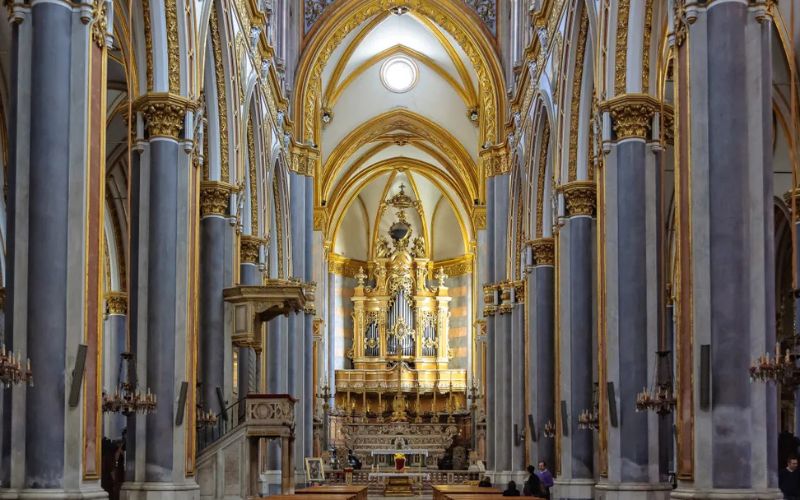
A significant part of Naples’ architectural character is its churches. Many of the city’s numerous old religious structures date back several centuries.
Cathedral of Naples:
The Duomo, or Naples Cathedral, is one of the most significant ecclesiastical structures in the city. Its lengthy history has produced a blend of artistic and architectural influences.
Gesù Nuovo:
The distinctive exterior stone pattern of the Church of Gesù Nuovo makes it particularly identifiable. A beautifully adorned holy area with a strong Baroque character may be found inside.
Chapel Sansevero:
The intricate sculptures and exquisite interior of the Sansevero Chapel are well-known. It offers a great illustration of how religious art, sculpture, and architecture may coexist in the same historic setting.
Santa Maria la Nova:
Another ancient ecclesiastical building that captures Naples’ artistic and architectural growth is Santa Maria la Nova. Its interior features ornamental elements that highlight the value of art in old churches.
San Domenico Maggiore:
Located in the center of Naples, San Domenico Maggiore is a significant historic church. It is a fascinating destination for anyone studying religious architecture because of its expansive construction and lengthy history.
Why Do Palaces in Naples Matter – Discover Palaces!
Another significant aspect of Naples’ architectural history is its historic palaces. These structures were frequently associated with royal life, powerful political figures, or affluent families.
In addition to serving as residences, palaces were intended to be representations of power and wealth. Strong visual impressions were produced by large entrances, courtyards, staircases, balconies, ornate ceilings, and roomy spaces.
While their interiors may have intricate architectural details, some palace facades are rather straightforward from the outside.
Numerous palace doors and balconies that are simple to miss can be seen while strolling through historic areas. Because Naples architecture may be enjoyed from street level to upper storeys, looking upward is frequently a helpful habit.
What Role Do Streets Play in Naples Design – Walk Streets!
Naples’ streets play a significant role in the city’s architectural identity. Narrow roads, closely spaced buildings, balconies, modest businesses, churches, and public squares are common features of historic communities.
Spaccanapoli, a lengthy urban street that passes through the historic center, is connected to one of the most well-known historic regions.
The street setting demonstrates the relationship between architecture and everyday life. Structures are not standalone monuments. They create communities where people travel, live, work, shop, and socialize.
Naples may feel different from a conventional museum for this reason. Everyday existence still involves architecture.
How Can the Architecture of Naples Be Read – Examine Structures!

An architectural tour can be greatly enhanced by learning how to observe buildings. To grasp the fundamentals, you don’t have to be an architect.
Examine Construction Materials:
A building’s age and purpose can be inferred from its stone, brick, plaster, wood, and metal components. Various materials were in style at different times.
Take note of doors and entrances:
Important historic structures are sometimes indicated by large entrances. The original status of a building can be inferred from ornamental doorways, arches, columns, and stone frames.
Examine balconies:
In Naples, balconies are a common feature. A building’s look can be significantly influenced by their shape, railings, supports, and decoration.
Examine Windows:
Architectural style can be seen through windows. Between historical eras, their size, form, frames, shutters, and ornamental elements frequently vary.
Pay Attention to Public Areas:
Squares, fountains, steps, and roadways are all elements of architecture. They show how buildings were organized around public life.
What Role Does Neapolitan Architecture Play Today – See Today!
Naples is more than just a historic city that has been preserved. People still reside in this contemporary city among structures that date back hundreds of years.
Historic buildings serve as residences, commercial establishments, places of worship, tourist destinations, museums, lodging facilities, and public buildings.
Opportunities and difficulties are brought about by this. While modern living necessitates practical upgrades like transportation, safety systems, accessibility, and updated services, older structures require maintenance.
Architectural history can be safeguarded through effective preservation, which also keeps historic districts functional and dynamic.
This equilibrium is crucial because a city has greater significance when its past is still relevant to the present.
How Are Naples Protected by Preservation – Preserve Cultural Traditions!
Future generations will be able to enjoy Naples’ unique character thanks to architectural preservation. Cultural value, educational opportunities, tourism benefits, and a closer bond with local history can all be found in historic structures.
Preservation could entail:
- Fixing old facades
- Preserving ornamental elements
- Keeping up historic churches
- Maintaining Archeological Remains
- Repairing ancient interior spaces
- Increasing the security of buildings
- Protecting ancient streets
- Responsible tourism management
Maintaining a building in its original state is not necessarily necessary for preservation. An old building can frequently continue to serve a practical modern function with proper restoration.
Why Examine the Architecture of Naples – Arrange Your Trip!
Naples’ architecture offers an alternative perspective on the city. You might focus on streets, architectural details, courtyards, cathedrals, palaces, and archeological relics rather than just well-known tourist destinations.
The city’s blend of several historical eras is its main draw. Influences from Greek, Roman, medieval, Spanish, Baroque, Neoclassical, and modern cultures can coexist in the same urban setting.
This opens up countless possibilities for those who enjoy architecture.
Learning a little bit about the background of each location can help make a visit more meaningful. A straightforward stroll can be transformed into a cultural experience by understanding the rationale behind a building’s construction or the evolution of a neighborhood.
Why Is Naples a Living Architectural Narrative – Past Experiences!

Because its past is still evident in the present, Naples might be characterized as a living architectural narrative.
Beneath contemporary streets are ancient subterranean buildings. Religious communities are still served by historic churches. Old palaces can still be seen in vibrant districts. Everyday life is still supported by traditional roadways.
The city serves as an example of how architecture is more than just individual structures. Time, people, culture, geography, and everyday activities are all important aspects of it.
Naples is fascinating because of this. You are not just observing historic buildings. You are witnessing how the same urban environment has been built upon, modified, preserved, and inhabited by successive generations.
When taking a walking tour, what should you observe – Take a Walk in Naples!
Take your time and seek beyond the main sites if you want to independently investigate Naples’ architecture.
Start by examining how the streets and buildings relate to one another in the historic core. Discover the underground city, tour a historic palace, and pay a visit to a few significant churches.
As you stroll, take note of:
- Facades of buildings
- Stone entrances
- Balconies
- Windows
- Churches
- Courtyards
- Street plans
- Public squares
- Historic markers
- Remains of archeology
Taking images of architectural elements might also help you remember what you saw. Respect local laws, private property, and limitations within historic structures, however, at all times.
Which Architecture Advice Is Best for Visitors – Be Wise When Traveling!
An architectural tour of Naples can be made simpler with a little preparation.
Prior to coming, find out when museums, cathedrals, archeological sites, and guided underground excursions are open. Certain historic sites could have set hours for visitors.
Second, since exploring old districts frequently requires walking on steps, uneven ground, and congested roads, wear comfortable shoes.
Third, don’t try to see everything in a single day. There is enough architectural heritage in Naples to justify a number of walking routes.
Lastly, spend some time observing regular buildings. It’s possible that some of the most intriguing architectural features are not found at well-known locations.
FAQs:
What is the reputation of architecture in Naples?
Ancient, medieval, Spanish, Baroque, Neoclassical, and modern elements are all mixed together in Naples’ architecture. The city is particularly unique because of its subterranean archeological areas.
Why is the architecture of Naples distinct?
Naples is distinct due to the coexistence of several historical strata. While antique cathedrals, palaces, and traditional dwellings continue to be vital elements of the city, ancient remnants can be found beneath contemporary streets.
Which structures in Naples are well-known?
Castel Nuovo, Castel dell’Ovo, the Royal Palace, Teatro di San Carlo, Naples Cathedral, and a number of ancient churches and palaces are significant architectural landmarks.
Is it possible for visitors to explore Naples’ underground?
Indeed, a number of subterranean and archeological sites are accessible via scheduled excursions or approved visitor locations. It is advised to check official information prior to going as access and availability may differ.
Which architectural styles are prevalent in Naples?
Greek and Roman ruins, medieval architecture, Spanish influences, Baroque ornamentation, Neoclassical architecture, and contemporary architecture may all be seen in various areas of Naples.
Conclusion:
Naples’ architecture is much more than just an assortment of historic structures. It is a narrative that has been written in public squares, churches, palaces, underground passageways, streets, and regular households.
The architectural development of the city demonstrates how several historical eras and civilizations influenced Naples over time. Its character is influenced by Baroque churches, royal buildings, Neoclassical areas, medieval architecture, Spanish influence, ancient Greek and Roman foundations, and contemporary growth.
The way these layers continue to be connected is what makes Naples so interesting. A visitor can see an ancient palace, stroll through a contemporary neighborhood, find a church that dates back hundreds of years, and then explore archeological areas beneath the city.













Leave a Reply