

Can I Use Exterior Paint Inside! You’ve undoubtedly wondered if you can use exterior paint indoors if you’ve ever completed an outdoor painting project and found yourself staring at cans of leftover exterior paint. It appears to be a straightforward and useful concept. I mean, paint is paint.
The answer isn’t that easy, though. Using exterior paint inside your home might really cause more issues than it solves, despite the fact that it may seem like a decent way to save money.
We’ll go over everything you need to know in this guide, from compatibility issues to health concerns, so you can make the best choice for your family and your house.
Table of Contents
What Distinguishes Exterior Paint from Interior Paint?
Let’s first examine the differences between exterior and interior paint before we address the main subject.
Interior paint is designed specifically for interior surfaces such as walls, ceilings, and rooms. It is made to be safe to use in enclosed areas with little fresh air, resilient to scuffs, and simple to clean.
Exterior paint is designed for external surfaces such as doors, decks, siding, and fences. Rain, heat, cold, UV rays, and humidity are among extreme weather conditions that it must withstand. As a result, it has unique compounds that give it flexibility, water resistance, and mold and mildew resistance.
It can be problematic to use one of these two types of paint instead of the other because they are designed for quite different situations.
Can Paint from the Outside Be Used Inside? The Brief Response!
In general, you shouldn’t apply outside paint inside your house. This is primarily due to two factors:
- Health and safety issues brought on by dangerous chemicals
- Unsuitable for interior conditions and surfaces
- Let’s examine each of these in more detail.
- VOCs in Exterior Paint: A Health Risk
VOCs, or volatile organic compounds, are the primary and most significant reason to avoid applying outside paint indoors.
VOCs: What Are They?
Chemicals known as volatile organic compounds (VOCs) can be found in a variety of household items, such as paint, furniture, carpet, cabinetry, and flooring. VOCs are emitted into the atmosphere as gas when these goods are used or applied. We refer to this process as off-gassing.
VOCs may not be harmful right away at low concentrations. However, they can be hazardous at high concentrations, particularly in confined areas with little ventilation, such as the interior of your house.
Why Are There More VOCs in Exterior Paint?
The purpose of exterior paint is to endure harsh external environments. In order to increase the paint’s durability, flexibility, and weather resistance, producers add additional chemicals, including increased quantities of volatile organic compounds (VOCs).
The outcome? When compared to interior paint, outside paint can emit up to 17 times more volatile organic compounds (VOCs) into the atmosphere. That is a significant difference, and using it in a confined place can have dire repercussions.
What Effects Do VOCs Have on Health?
High VOC exposure can result in:
- Headaches and lightheadedness
- Vomiting and nausea
- discomfort of the throat, nose, and eyes
- Breathing difficulties
- Long-term exposure can harm the kidneys, liver, and central nervous system.
Particularly at risk are children, the elderly, and persons with respiratory disorders like asthma.
How Much Time Do VOCs Last?
This is where the situation becomes even more problematic. VOCs from exterior paint might remain for days, weeks, or even months inside an enclosed room, whereas VOCs from interior paint typically disappear within a few days with enough ventilation.
These harmful gases can accumulate to hazardous amounts and remain trapped inside for an extended period of time since dwellings are not as well-ventilated as the outdoors.
Compatibility Problems: The Reasons Outside Paint Isn’t Effective Indoors
In addition to health risks, exterior paint is just not meant for indoor use. This is the reason:
1. Exterior Paint Is Too Soft for Surfaces Inside

Paint for the outside is designed to expand and contract in response to temperature variations. Between seasons and even between day and nite, outdoor temperatures can fluctuate significantly. Exterior paint has a softer, more flexible formula to deal with this.
However, this flexibility becomes problematic inside. Rigid and durable paint is required for interior walls; it must be able to withstand hand marks, furniture scuffs, and frequent cleaning. Because outside paint is softer.
Conversely, interior paint is more inflexible. Its stiffness makes it far more resilient to normal wear and tear, such as bumps, washing, and cleaning, than outside paint ever could.
2. You Use More Paint When Your Spread Rate Is Lower
The slower dispersion rate of external paint in comparison to inside paint is another practical issue.
This is what it signifies in terms of basic numbers:
- About 375 square feet can be painted with one gallon of interior paint.
- About 300 square feet can be covered with one gallon of exterior paint.
- Therefore, if a 1,500 square foot area needs to be painted:
- Four gallons of interior paint are required.
- Five gallons of exterior paint are required.
For the same amount of room, that is an additional gallon. Therefore, even if you use leftover exterior paint in an attempt to save money, you will ultimately use and spend more.
3. Extended Recoat and Drying Times
Additionally, outside paint takes longer than interior paint to cure and recoat, and this issue worsens indoors.
Here’s a little comparison:
- Touch-Dry Recoat Time
- Interior Paint: 1–2 hours
- About an hour for exterior paint
- For a maximum of four hours
It takes around an hour for both kinds of paint to dry to the touch. However, exterior paint can take up to four hours to apply a second coat, whereas interior paint is ready in one to two hours.
Now consider the issue of poor interior ventilation. Drying time is accelerated by good ventilation. There is a lot of fresh air circulating outside. However, there is little ventilation inside a room, so it will take even longer for exterior paint to completely dry between coats.
Is It Possible to Use Exterior Paint Inside?
Yes, but only in extremely rare and special circumstances.
Interior spaces with adequate ventilation that are not used as living areas can use exterior paint.
Among them are:
- Garages
- Sheds
- Workshops
- Outbuildings for storage
These locations often have greater airflow (open garage doors, vents, etc.) and are not places where your family spends long periods of time. Thus, the risk of VOCs is significantly reduced.
But even in these situations, you should only use exterior paint indoors if you are attempting to use up leftover paint. This is crucial. If you are going out to buy new paint, always choose the right type for the right surface.
How About Applying Interior Paint Outside?
While we’re on the subject, a lot of folks are also curious about the opposite: is it possible to apply interior paint outside?
Fortunately, indoor paint does not pose the same health dangers as outside paint. VOCs and odors spread swiftly into the open air when you’re outside and don’t build up to hazardous concentrations.
Unfortunately, interior paint is just not designed to withstand outdoor conditions. When you use it outside, the following occurs:
It’s going to break. Interior paint is stiff and not designed to expand and contract with changing temperatures. Outdoors, where temperatures change considerably between seasons, the paint will break and peel quite rapidly.
No defense against mold and moisture. Exterior paint contains fungicides and other compounds that protect against moisture, mildew, and mold. Interior paint has none of these, thus it will absorb moisture and allow mold to grow on outdoor surfaces.
Colors fade more quickly. Exterior paint is specifically developed to resist UV radiation from the sun. Interior paint has no such protection, so its colors will fade and look dull much sooner than exterior paint would.
Bottom line: use interior paint inside, and exterior paint outside. Each is created for its specific setting.
Which Paint Is Best for Interiors?
What should you use instead of outside paint now that we know it’s inappropriate for internal use?
The best option for the majority of interior walls and ceilings is 100% water-based acrylic-latex paint, often known as latex paint or acrylic paint. This kind of paint:
dries fast.
- has minimal amounts of VOCs
- is simple to clean up with water.
- comes in an extensive range of colors and finishes.
- is long-lasting and robust for indoor use.
- Selecting the Proper Gloss for Every Space
Depending on the space you are painting, you must select a gloss level within the acrylic-latex family:
Matte or flat: Ideal for low-traffic areas and bedrooms. effectively conceals flaws but is more difficult to clean.
Eggshell: Not quite flat, but slightly shiny. Excellent for bedrooms and living spaces. easier to clean than matte.
Satin: A gentle sheen that is simple to remove. Excellent for family spaces, children’s rooms, and hallways.
Semi-gloss: Easier to clean and more shiny. Perfect for trim, baths, and kitchens.
High-gloss: incredibly durable and glossy. Ideal for cabinets, doors, and trim.
Always ensure the label at the paint retailer says “Interior Paint.” Ask specifically for interior paint if you are having paint mixed at the counter.
Which Paint Is Best for Exteriors?
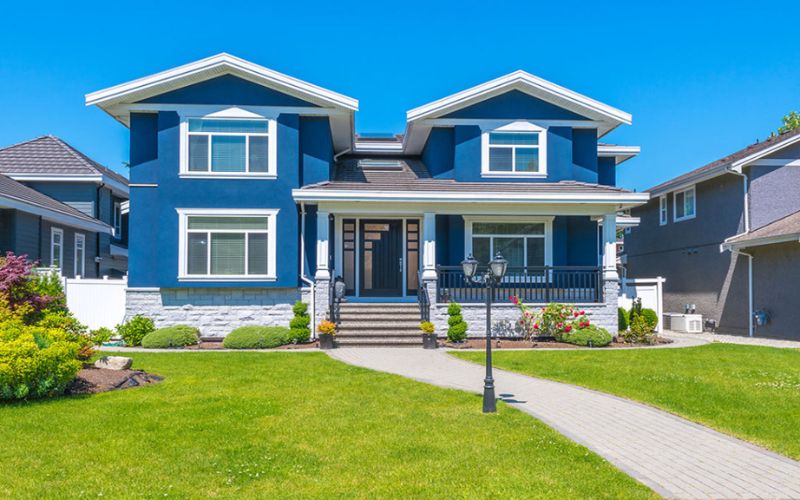
100% water-based acrylic-latex paint is likewise the preferred option for outside surfaces; however, it is referred to as exterior paint. For the majority of house siding and trim, this works nicely.
Take into account these choices for additional protection on particular outdoor surfaces:
oil-based enamel paint for metal surfaces, trim, and external doors. Although it requires solvent-based cleansers and takes longer to cure, it offers incredibly robust defense against rust, scuffs, and inclement weather.
Masonry paint for surfaces made of concrete, stone, or brick.
For wooden decks and porches, deck paint or stain is specifically designed to manage moisture and foot activity.
To avoid fading, always select an exterior paint with UV protection. If you live in a humid area, search for paints that are resistant to mold and mildew.
A Brief Overview of Interior vs. Exterior Paint
- A feature
- Paint for Interiors
- Paint on the outside
- Levels of VOCs
- Extremely High
- Sturdiness Indoors
- Outstanding
- Unfortunate
- Rate of Spread
- 375 square feet per gallon
- 300 square feet per gallon
- Time to Recoat
- One to two hours
- For a maximum of four hours
- Adaptability
- Stiff
- Adaptable
- Ideal For
- Indoor walls and ceilings
- Outside, fences, and siding
Conclusion:
Can external paint be used indoors, then? Yes, in theory, but you really shouldn’t, especially in a living area. It is not worth taking because of the high VOC levels alone, which pose a health risk. When you consider the decreased coverage rate, shorter drying periods, and poor performance on indoor surfaces, it’s obvious that exterior paint isn’t the right solution for the job.
For indoor areas, use interior paint; for outdoor surfaces, use exterior paint. If you want to use up any extra exterior paint, make sure the location is well-ventilated and limit it to non-living areas like sheds or garages.











Leave a Reply